
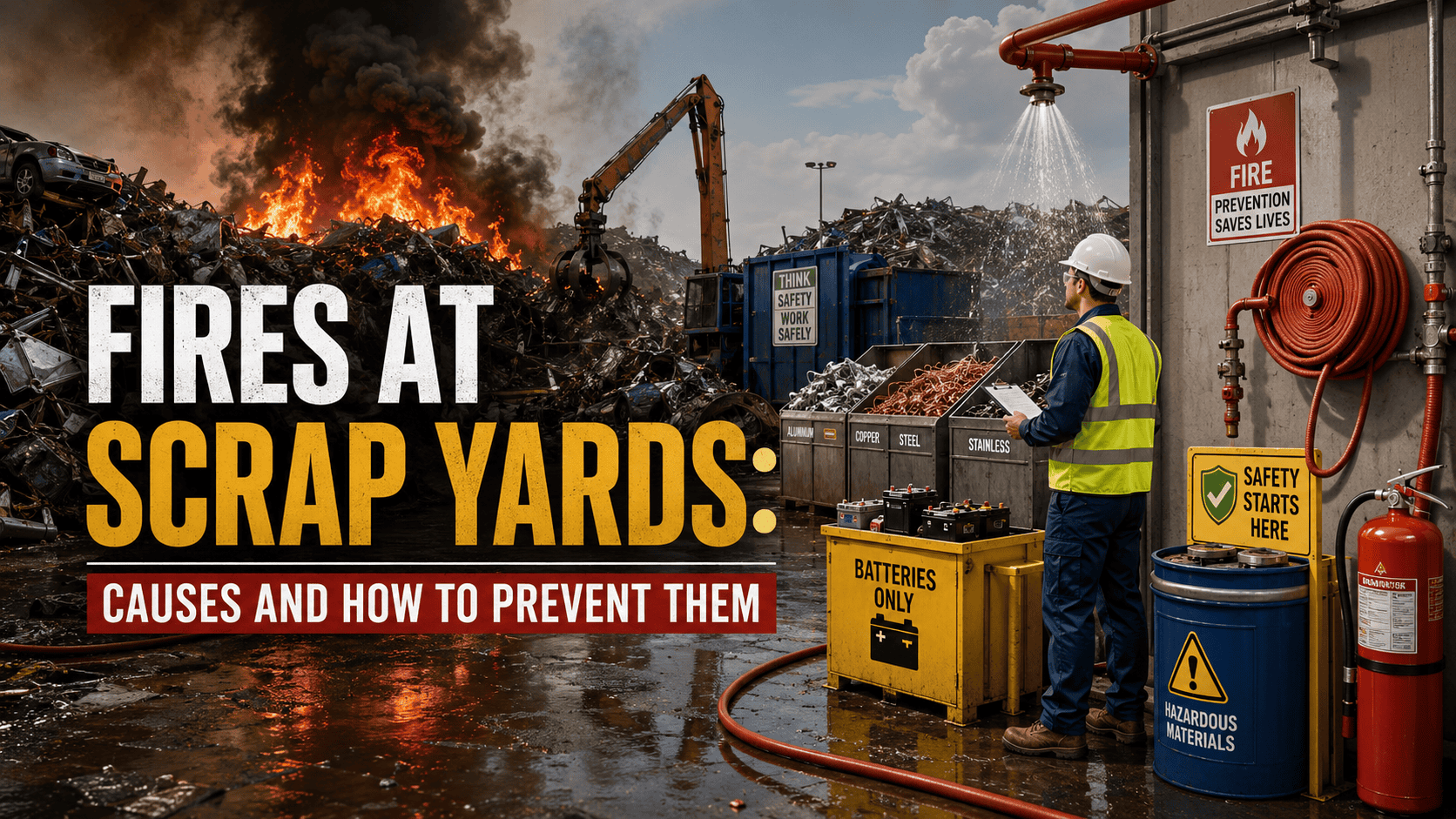
Scrap yard fires used to be a once-a-year worst-case scenario. Now they happen across Ontario and the rest of Canada multiple times a month.
In Hamilton alone, recent years have seen multiple-alarm fires at scrap yards on Parkdale Avenue North, including a 2023 blaze that caused $150,000 to $200,000 in damage and spread to an adjacent home’s fence and garage. American Iron and Metal (AIM Recycling) at Parkdale and Burlington Street has also had multiple fire incidents that sent smoke plumes across the downtown core, prompting Ontario Ministry of the Environment air quality testing (source: Global News, CHCH).
Across North America, publicly reported fires at waste and recycling facilities hit a record 430 incidents in 2024, up from 373 in 2023 and 272 in 2016, a 58% increase in nine years (source: Fire Rover, via Resource Recycling).
For a scrap yard operator in Hamilton or anywhere in Ontario, that is not just bad news. That is your insurance premium, your downtime, your workers’ safety, and your reputation, all in one statistic.
This article breaks down why scrap yard fires are increasing, what is causing them, and what actually works to prevent them.
The Quick Take
Most scrap yard fires today come from one source the industry did not have to worry about ten years ago: lithium-ion batteries. Add the traditional risks (fuel, oils, sparks, propane tanks, tires) and you get a perfect ignition environment.
Prevention is no longer a single fix. It is a layered system of inspection, separation, detection technology, and trained staff.
Scrap Yard Fires Are Trending the Wrong Way
The numbers tell the story.
| Year | Reported Waste & Recycling Facility Fires (US/Canada) | Year-Over-Year Change |
|---|---|---|
| 2016 | 272 | Baseline |
| 2023 | 373 | Down 4% |
| 2024 | 430 | Up 15% |
| Q1 2025 | 104 | Record first quarter |
Source: Fire Rover annual reports
The Canadian picture is just as alarming:
- Toronto: Lithium-ion battery-related fires jumped 90% in 2023 compared to 2022, prompting Toronto Fire Services to launch the “This is Your Warning” campaign with the Ontario Fire Marshal.
- Ottawa: At least 60 lithium-ion battery fires since 2022, according to Ottawa Fire Services.
- Metro Vancouver: Each of the region’s six waste centres now experiences 3 to 4 battery-caused fires per year, per Metro Vancouver solid waste engineering.
A few things stand out.
First, 2023 looked like progress. The industry was rolling out detection systems and public education. Then 2024 wiped out the gains.
Second, Q1 2025 already broke records. Fires used to slow down in winter. That pattern is gone.
Third, this is only the publicly reported number. Most facilities are unprotected, and most small fires never make the news.
The Main Causes of Scrap Yard Fires
Lithium-Ion Batteries Are The Top Threat
Lithium-ion batteries are the single largest fire risk in scrap recycling today.
They show up hidden inside:
- Laptops, phones, tablets
- Power tools and cordless appliances
- E-bikes and e-scooters
- Vape pens and disposable vapes
- Auto components and EV battery packs
When these batteries get punctured, crushed, or shorted during shredding or compacting, they enter thermal runaway: a self-sustaining chemical reaction that generates intense heat and ignites everything around it.
Ontario Fire Marshal Jon Pegg put it bluntly: “When they fail, they can unleash a chain reaction that results in an intense fire that can spread in seconds, release toxic smoke, and make escape incredibly difficult.”
The scale of the problem is hard to overstate. An estimated 1.2 billion disposable vapes enter waste and recycling streams every year, almost all of them containing lithium-ion cells with no widely available drop-off program.
Recycle Your Batteries, Canada! drop-off locations exist across Ontario, but consumer awareness is still catching up. Batteries under 5 kg can go to retail drop-offs (The Home Depot, etc.). Batteries over 5 kg need to go to a municipal hazardous waste depot. Hamilton operates Community Recycling Centres on Mountain (1313 Upper Ottawa St.) and Dundas (171 Lower Lions Club Rd.) for hazardous waste drop-off.
Vehicle Components and Residual Fluids
End-of-life vehicles bring a long list of fire fuel onto the yard, even after fluids are supposedly drained.
| Vehicle Hazard | Risk |
|---|---|
| Gasoline, oil, coolant residue | Ignites from sparks or heat |
| Plastics, foam, paint, rubber | High fuel load, toxic smoke |
| Magnesium engine parts | Burns hot, reacts violently with water |
| 12V batteries | Can short and spark |
| EV battery packs | Thermal runaway, hard to extinguish |
Magnesium is especially dangerous because standard firefighting tactics make it worse. Pouring water on burning magnesium can intensify the reaction.
Sparks from Cutting, Shredding, and Equipment
Torch cutting, grinders, balers, and shredders all generate sparks and friction heat. Land that on oily rags, foam, paper, or dried grass and you have a fire in seconds.
Shredder feed is the highest-risk operation in the yard. Shredding is exactly what damages hidden batteries and pressurized containers worst.
Self-Heating in Stored Piles
Big piles of mixed scrap can ignite on their own. Decomposing organics, metal oxidation, and trapped heat raise internal temperatures beyond ignition thresholds without any external spark.
The 2023 Parkdale Avenue fire in east Hamilton showed exactly this pattern. Crews found multiple scrap vehicles ignited in the yard at 2 a.m., with no obvious external cause. By the time they arrived, the radiant heat had already set fire to a neighbouring backyard fence and garage.
Pressurized Containers
Propane tanks, aerosol cans, fuel canisters, and old chemical drums sneak into loads constantly. Crush or heat them and you get a fast-spread fire or an outright explosion.
Tires, Paper, Rags
Tires burn at extremely high temperatures and release toxic smoke. Ontario regulations limit how many can be stored on a single site for exactly this reason. Paper, cardboard, oily rags, and wood pallets are quick-ignition fuel that helps small fires become big ones.
Human Error
Cigarette butts, lighters left in pockets, hot work without a fire watch, and lazy housekeeping still cause a measurable share of scrap yard fires. Equipment cannot fix culture.
The Real Cost of a Scrap Yard Fire
Operators sometimes underestimate the damage because the metal is still there afterward. The actual cost runs much deeper.
| Cost Category | Typical Impact |
|---|---|
| Equipment damage | Shredders, loaders, conveyors often total losses |
| Operational downtime | Days to weeks of shutdown |
| Insurance premiums | Sharp hikes, sometimes policy non-renewal |
| Environmental fines | MECP enforcement on runoff into Hamilton Harbour or local creeks |
| Worker and responder injuries | 6% of 2024 incidents involved injury or death |
| Site contamination | Heavy metals, PFAS, hydrocarbons left behind |
| Community pushback | Air quality complaints, zoning challenges |
| Property damage | Hamilton fires have spread to neighbouring homes |
Post-fire contamination is its own problem. Lithium-ion battery byproducts can corrode metal at extreme rates and leave behind hazardous residue. A Toronto-area investigation cited by industry experts found that after a single residential lithium battery fire, the home showed corrosion in outlets, tools, and the HVAC system within days. The same byproducts hit a scrap yard much harder.
After a serious fire, sites often need professional biohazard and contamination cleanup before they can safely resume operations.
How to Prevent Scrap Yard Fires
No single solution works. The yards that stay safe layer multiple defences.
1. Inspect Every Incoming Load
A fire that starts at intake should have been caught at the gate.
- Visual inspection for batteries, propane tanks, aerosols
- Refuse contaminated loads outright
- Price incentives that discourage suppliers from hiding hazards
- X-ray or AI-assisted screening for higher-volume yards
2. Isolate Lithium-Ion Batteries Immediately
Treat every battery you find as a live ignition source.
- Store in non-combustible containers
- Keep quarantine area separate from main piles
- Label clearly
- Train every employee on identification, not just supervisors
- Direct customers to drop batteries at Recycle Your Batteries, Canada! locations or Hamilton’s Community Recycling Centres
3. Manage Pile Size and Spacing
Smaller piles burn smaller. Industry guidance recommends:
- Minimum 6 feet between piles
- Wider gaps for high-risk materials
- Height limits to prevent deep-seated fires
- No mixing of auto bodies with light combustibles
4. Invest in Early Detection
Standard fire alarms trigger after the fire is already established. Thermal imaging and remote-monitored detection systems catch heat anomalies before flames appear.
- Thermal cameras for shredder areas and storage piles
- Remote-monitored detection systems (Fire Rover and similar)
- Infrared hot-spot monitoring on conveyors
5. Walk the Yard Daily
Cameras catch what people miss. People catch what cameras miss.
Set a fixed schedule for supervisors to walk piles looking for smoke, steam, heat shimmer, or unusual smells. The first ten minutes of a fire is everything. The 2023 east Hamilton fire on Parkdale Ave was first spotted at 2 a.m., long after it had taken hold. Earlier detection would have saved the neighbouring property.
6. Control Hot Work
- Designated cutting and welding zones away from combustibles
- Fire watch during and 30 minutes after any hot work
- Spark shields on all grinders
- Extinguishers within arm’s reach
- Ban smoking and vaping anywhere in operational areas
7. Plan Water Supply Before You Need It
Many scrap yards sit at the end of municipal water mains. Confirm flow rates, hydrant locations, and access routes with Hamilton Fire Department or your local fire service now, not during an incident.
8. Train Staff Repeatedly
One-time training does not stick. Run sessions multiple times per year covering:
- Load inspection
- Battery handling
- Pile management
- Hot work rules
- First-60-seconds response
9. Build a Relationship with Hamilton Fire Department
Invite fire crews to walk your yard before they ever respond to a call. Share your site plan, hazard map, water supply, and access points. Pre-incident familiarity cuts response time and can save lives.
10. Follow the Ontario Fire Code
Every scrap and recycling operation in Ontario is regulated under the Ontario Fire Code (Reg. 213/07 under the Fire Protection and Prevention Act). The Government of Ontario’s Office of the Fire Marshal publishes specific guidance on lithium-ion battery hazards, including that damaged batteries must be isolated from other combustibles and treated as immediately dangerous to life and health.
Compliance is not optional. The Ontario Fire Marshal investigates serious fires at commercial operations, and findings can affect your licensing, your insurance, and your ability to operate.
Quick Reference: Fire Prevention Checklist
| Area | Action | Frequency |
|---|---|---|
| Incoming loads | Inspect for batteries, propane, aerosols | Every load |
| Battery storage | Isolate in non-combustible containers | Immediate |
| Pile spacing | Maintain 6+ feet between piles | Ongoing |
| Detection | Thermal imaging or remote monitoring | 24/7 |
| Yard walks | Visual check for smoke, heat, smells | Multiple times daily |
| Hot work | Fire watch active | Every job |
| Staff training | Refresher sessions | 3 to 4 times per year |
| Fire department | Site walk-through | Annually |
| Ontario Fire Code | Compliance audit | Annually |
The Bottom Line
Scrap yard fires are not random bad luck. They are the predictable outcome of taking in flammable, pressurized, and battery-laden material in large volumes.
Lithium-ion batteries are not going away. Vehicle electrification, e-bikes, vapes, and consumer electronics keep growing in Hamilton and across Ontario, and those batteries keep ending up in scrap streams.
The yards still operating in five years will be the ones that invested now in:
- Better intake screening
- Battery isolation procedures
- Early detection technology
- Trained staff
- A working relationship with Hamilton Fire Department and the Ontario Fire Marshal
Fire prevention at a scrap yard is not a one-time project. It is a daily operational discipline. The cost of doing it right is always less than the cost of cleaning up after a fire that should not have happened.